We don’t often talk about being Consultants.
Often we will talk about the general things that are happening within the economy or within the Supply Chain and Logistics sector to try and give our view on changes that are directly impacting behaviours in the marketplace.
What we very rarely talk about is what life is like for a Supply Chain and Logistics Consultant. Being a consultant provides wonderful insights into the performance of the economy as a whole, where we get to see on the inside of a wide variety of organisations. But it can also be extremely challenging in terms of delivering consistent cost-effective change to a very varied Customer base.
We’re not here to just ‘Borrow your Watch’
The old adage about consultants is that they will ‘borrow your watch to tell you the time’. This is often an attitude that I and our team may come across when meeting clients and their teams for the first time. To some respect, it is actually true. There is a need for a Supply Chain consultant to be able to correctly tell their client everything they have learned about their business, and much of it they will already know. The borrowing your watch adage is where some people believe that the consultant adds no further value beyond that. This can make building relationships and understanding client needs altogether more challenging, but it is part and parcel of delivering results in a consultancy field. As mentioned, the challenge is then actually delivering impactful results to meet or exceed your client’s expectations.
When as a consultant, you do correctly demonstrate that you understand your client and your clients’ challenges, you have essentially built the initial blocks upon which you can build a high value and impactful strategy to meet that client challenge.
We would never go into a client’s Supply Chain operation to deliver our consultancy with a belief that we will always know better than the people and the organisation that we meet. What we will do is bring a fresh approach and a different perspective to the challenges they face. It is not about being a teacher in a classroom attempting to educate; it is more about helping your client to foster a culture where change is not only accepted but is desired.
As an example, I recently worked with a client who had struggled on for several years with a very manually driven process two develop daily vehicle planning schedules. When we were able to present to them a new way of working with an automated model that saved them hours of effort every day, we could see their initial scepticism being released and being replaced with excitement about how they could take what they had been given and mould it to meet their ways of working. They were not ‘educated’ or ‘cajoled’ but simply helped on their way by a team looking at things just a bit differently than they were able to do themselves.
The Need to Wear Many Hats
One of the real challenges about being a Supply Chain consultant is that you have to wear many hats in many different arenas. An individual consultant may simply work on one long-term project for an individual client, and in many respects that way of working is very similar to working in a BAU day job. However, that is not the life most consultants lead. That is more akin to interim management and specialist long-term solution consultancy. The kind of work we might typically do may see us and our team needing to work with multiple clients in multiple sectors all at the same time.
The challenge this brings is high in so much as you have to be exceptionally good at multitasking and demonstrating solution specific knowledge in whichever sector or business you are working in.
The benefit of working across so many different clients and projects is that you can also learn to adapt your approach in different environments and sometimes there are sector specific opportunities that can be applied in one environment that you may have previously carried out in another. You could argue that people moving from job to job and Company to Company do the same thing, and yes they do, but not with the level of frequency that a Supply Chain consultant has to do.
In one period of time I was directly involved in 27 separate client projects. That is an extreme example and not one I would wish to replicate in the near future again, but when you have that breadth of Customer contact and involvement you can do nothing but learn and share your wisdom with those that you happen to work with. You have to learn to balance your time effectively, or else you can sink under the demands of the role.
A life ‘on the road’
It is absolutely fair to say that since the Covid pandemic the world of Supply Chain consultancy and what a day looks like has changed remarkably, and absolutely for the better. Prior to Covid in our world we could easily clock up 50,000 miles a year in our cars travelling from client to client to client for meetings and discussions and site reviews. The Covid pandemic taught everybody that we can use the power of the Internet to protect us from that need to travel in the way that we used to have to do.
This does not mean we are any less diligent or present for our clients, in fact it provides us even greater adaptability and flexibility. You have to remember that in most clients, their teams are spread often far and wide perhaps across multiple distribution centres, regional offices etc. Simply physically being in that location is not beneficial when half the people you may need to meet may be based 100 miles away or more.
Whilst Covid has reduced the need for travel and improved business productivity considerably, what it has not done is completely eradicate the need to be on the road. We now travel but much more selectively and only when there is something that you have to see to understand. This is usually the case when we are reviewing warehouse operations or physical logistics solutions where the characteristics of the space and the product being handled within it are fundamental to understanding the challenges of the business.
In these revised, more modern working practices, a good Supply Chain consultant will still do everything they used to do. Attending sites at night if that is when they are at their busiest; visiting sites very early in the morning if that is when vehicles are being loaded; attending sites late into the evening if that is when all your trucks are returning to be reloaded for the following day.
So we do still travel considerably but thankfully for both ourselves physically and for the environment, the amount of road Miles we cover is now significantly reduced, I can comfortably do my job and do no more than 20,000 miles in a car each year. Some people may still think that is a lot of Miles by the way, and we are not saying it isn’t and we are forever looking at options to continue to reduce our requirement on face-to-face activity.
The need to consistently add value
Putting to one side the challenges of Travel, and the cultural challenges you may sometimes face with clients or parts of clients who may not quite fully understand the benefits of consultant can bring, a specific challenge we have to face with every engagement is to demonstrate we have added value to the client.
Of course in some cases that is easier than others. We are sometimes called in to review the Supply Chain operations or functions in some quite well-run businesses where many elements of the process function very well. That does not mean that we cannot add value. It just means that we may sometimes have to think a little out of the box as to how the business can continue to evolve its Supply Chain journey.
Sometimes our Supply Chain and Logistics Consultants come across businesses that are perhaps much more in need of our services. What we must be careful of every time we conduct an engagement is to avoid the risk of simply attempting to add value for value’s sake. There is no point producing fancy reports, lovely graphs and bullet point recommendations when actually that does not move things forward for the client.
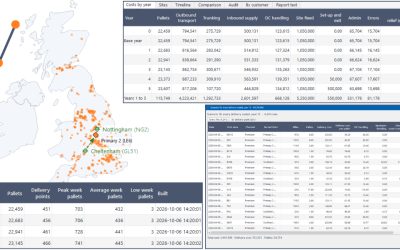
We have to clearly show (often visually) how and why change will be good, and what it will deliver. If we are not able to adequately demonstrate the benefit of change to process, people strategy, space, equipment etc., then we have not done our job right.
It can be challenging; but there are worse things to do
I can assure you from a personal perspective that being a consultant is not an easy life. You do not float from one project to another regurgitating things as some may believe. We actually work extremely hard to deliver precisely what each individual client actually needs, ensuring that we work closely to the client’s brief and providing all the right levels of insight required to ensure maximum value is added.
It is this need to provide insight that helps us keep ourselves fresh and keen to learn about all the latest developments in the marketplace. It also drives our desire to create the tools we need to help businesses improve. That is specifically why we have invested so much time and effort in our ASCALi SKUBE product analysis model. It is measures like this that help us to drive that real value our clients look for, to provide genuine step change opportunities for our clients to grow and improve their operations.
Find out More
If you would like to read more about how the team here at ASCALi can help you develop your Supply Chain solution, please take a look at one of our solution sector pages – Supply Chain Consulting; Warehouse Consulting; Transport Consultancy; or Logistics Consultancy.
Alternatively, why not just contact us to arrange an initial free consultation to talk about your Supply Chain challenge and where we can help at value for you.