Its a tough world out there…
In an economic environment defined by persistent inflation, frustratingly high energy bills, and pressure on labour availability, British businesses are being forced to reassess how their warehouses operate. For many organisations, warehousing has shifted from being a “back-of-house necessity” that acts purely as a cost centre to be minimised, to a “strategic lever” that can enhance net margins, improve service levels, and create resilience in a supply chain landscape that is increasingly unpredictable.
Below we explore how companies can redesign and optimise their warehouses to drive operational efficiency, reduce avoidable costs, and future-proof their logistics operations. We look at practical measures used by warehouse consultants like ours to drive that optimisation.
Why Efficiency Matters More Than Ever
Inflation affects warehousing in several interconnected ways. Energy costs—covering lighting, heating, cooling and fuel—have risen sharply, making outdated buildings particularly expensive to operate. Labour has become a major challenge too. A shrinking UK labour pool, and a rising National Living Wage means higher costs, leads to increased use of agencies, and more time spent training and retraining staff due to turnover. At the same time, customers expect faster, more predictable deliveries, which often increases pressure on warehouse teams that are already stretched.
All of this makes warehouse optimisation and re-deign a powerful lever for cost reduction. Modest improvements in layout, process flow, pick efficiency or building design can translate into significant savings that can support your business for the long term.
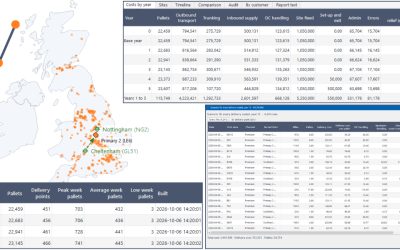
We start the process with your data…it should be front and centre of any optimisation process.
The first step in any redesign is a detailed understanding of the current operation. Our warehouse consultants typically begin with a diagnostic phase that examines how people, products and equipment move through the site. This includes studying travel distances, evaluating heat zones and bottlenecks, analysing storage utilisation and reviewing overall productive performance.
Many businesses are often surprised by how much inefficiency has accumulated over time. A poor warehouse layout can force staff to walk several unnecessary kilometres per shift. Inefficient pick routes, unclear replenishment flows, or under-utilised storage locations all add hidden cost. A data-led review reveals these issues clearly and provides the foundation for a targeted improvement plan.
Designing Layouts Around Product Velocity
One of the most powerful ways to improve efficiency is to redesign the warehouse around product velocity. Fast-moving items should be placed as close as possible to the points where they are dispatched, while slower-moving goods can be stored in less accessible areas. This principle, widely used by our warehouse specialists, reduces walking time, increases pick rates and lowers overall labour demand.
Some companies use analytical tools and sometimes AI-supported software to adjust SKU placement based on demand patterns. This dynamic slotting approach can ensure that warehouse flow evolves with seasonal trends, product launches and even viral spikes driven by social media.
At ASCALi, we add an additional layer to our analysis, using our in-house-developed Inventory ‘Cubes’ Model to analyse your product behaviours in 3-D, with a strong emphasis on your product’s commercial behaviours as well as logistics behaviours.
Maximising storage capacity within the existing footprint
With industrial property costs still high across the UK, expanding or relocating facilities is rarely the most cost-effective option. Instead, businesses can unlock significant value by optimising the space they already have. This might involve converting wide-aisle racking into narrower-aisle systems, introducing multi-tier mezzanines, deploying high-density storage, or simply using vertical space more effectively.
Our team of warehouse consultants often find that a building perceived as “full” can in fact accommodate 20–40% more capacity through strategic reconfiguration. This avoids the CapEx and disruption of moving sites, whilst simultaneously improving operational flow.
Enhancing pick face Design
The design of your pick faces has a direct impact on speed, accuracy and labour efficiency. Items should be placed at ergonomic heights, grouped logically, and supported by a smooth replenishment workflow that doesn’t interfere with picking activities. When pickers can work continuously without backtracking or confusion, output increases and training time decreases.
Our Warehouse Efficiency Consultants often find that pick face optimisation alone can deliver substantial improvements without requiring any new technology. In inflationary conditions, these high-impact, low-investment wins are extremely valuable.
If you would like to read more about our approach to warehouse optimisation, please go to our Warehouse Solutions page for more information.
Using automation strategically
Automation can transform warehouse operations, but adopting it blindly can lead to expensive mistakes. In the current economy, the goal is targeted automation that addresses specific operational requirements or challenges. This might include conveyor systems that remove unnecessary walking, automated packing equipment that speeds up despatch, or AMRs (autonomous mobile robots) that move goods between areas within your warehouse.
Other options—such as pick-to-light or voice-directed systems—can increase speed and/or accuracy for high-volume item picking. The key is to ensure automation supports the operation rather than dictating it. This is why businesses often work with our team to conduct cost-benefit assessments before committing to a solution. Where some CapEx for automation can run the £m’s this should be a definite step in your journey towards installations.
Standardising processes for reliability and Accuracy
As labour costs rise, it becomes increasingly important to design warehouse solutions that can operate efficiently with faster training and reduced dependency on experienced staff. Standardised processes, supported by clear signage, consistent labelling, logical spatial design and well documented workflows will help eliminate errors and maintain productivity even when teams change.
 Process standardisation also reduces the operational risk associated with sudden labour shortages or peak season surges. For many warehouses, improving process clarity becomes just as important as improving physical layout.
Building a Culture of Continuous Improvement
A warehouse redesign should not be a one-off exercise. The most resilient operations develop a culture of continuous improvement, supported by regular audits, daily team huddles & briefings, KPI monitoring, and root-cause analysis of issues such as mis-picks or delayed orders. Continuous improvement keeps the warehouse responsive to economic pressures and customer expectations, helping businesses adapt without incurring major new costs.
Leveraging External Expertise
With so many factors affecting modern warehouse operations…from labour market challenges to energy efficiency and automation…many companies turn to warehouse consultants like ourselves to help guide improvements. External specialists bring an objective view and proven methodologies that accelerate results. In many cases, the savings delivered by a redesign outweigh the cost of the consultancy work within a short time. Sometimes the fees are paid off by quick wins alone.
Warehouse efficiency as a driver of Competitive advantage
In an inflationary economy, efficient warehouse solution design is no longer just an operational upgrade—it is a strategic imperative. Well-designed warehouses reduce labour dependency, increase storage capacity, minimise errors, improve energy efficiency and enhance customer satisfaction, all of which directly support profitability. Whether through internal optimisation efforts or by engaging our experienced warehouse consultants, UK businesses have a significant opportunity to redesign their warehouses for long-term resilience and competitive advantage.
Contact the team at ASCALi now to arrange a free consultation to discuss your warehouse solution challenges.